
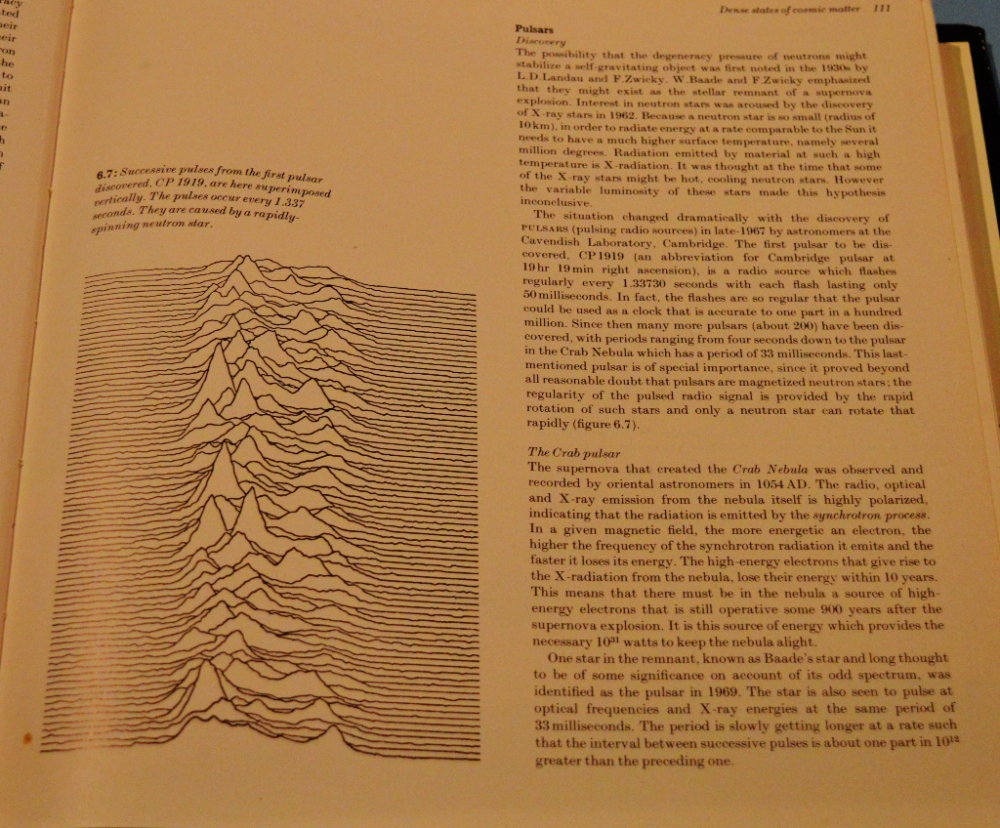
What is CP1919?
CP1919 is a pulsar: a rapidly rotating neutron star whose radio beam sweeps past Earth at regular intervals. Jocelyn Bell Burnell identified its signal while working as a research student at Cambridge, with Antony Hewish.
The lines on the sleeve show how the strength of a radio signal changes across successive pulses.
Meet Jocelyn Bell BurnellWho drew the original diagram?
Harold D. Craft Jr. created the stacked plot from radio observations made at the Arecibo Observatory in Puerto Rico. It appeared in his 1970 Cornell doctoral thesis.
By offsetting successive pulses vertically, Craft could compare their shapes. The result was a tool for reading data before it became a symbol for anything else. Scientific American later published the figure in 1971.
Meet Harold CraftHow did it reach the band?
The image was reproduced in The Cambridge Encyclopaedia of Astronomy, edited by Simon Mitton. The photograph above shows that page, with Craft’s diagram printed in black on white.
Accounts differ on whether Bernard Sumner or Stephen Morris first selected it. The band’s role in choosing the image and Craft’s role in creating it are both part of its provenance.
Look closer at the book pageOne cover. Two colour stories.
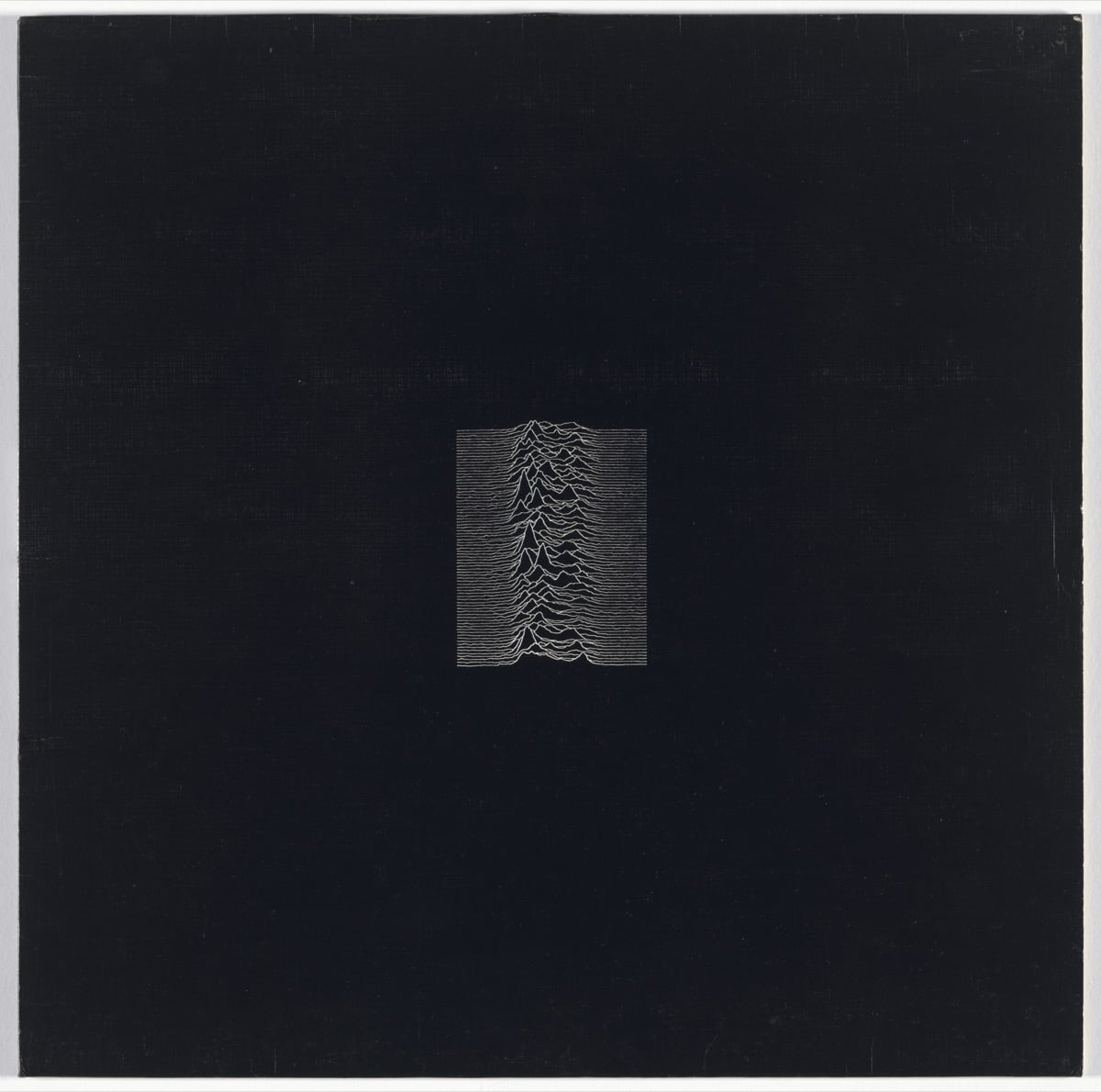
Saville reversed the diagram into white lines on black. He gave the image room and left the band name and album title off the front. The first sleeve used textured card.
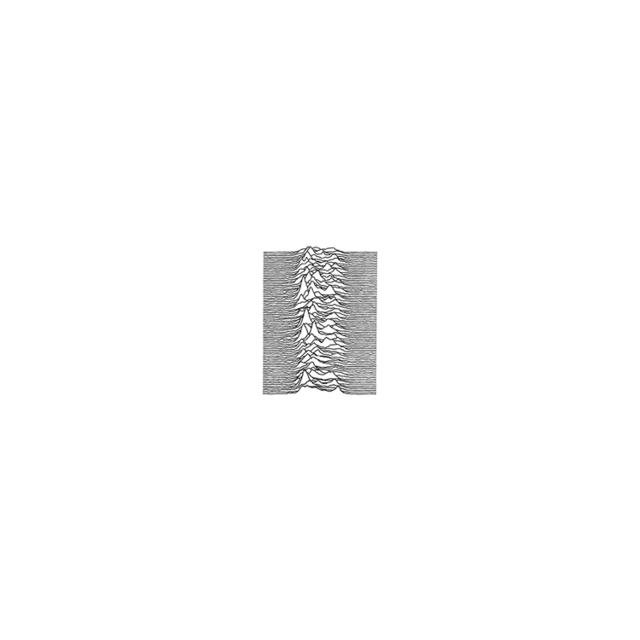
For the 40th anniversary, Rhino released the album on ruby-red vinyl in an alternative white sleeve. New Order’s official account describes that colour scheme as Saville’s original intention.
The 1979 sleeve also belongs to the Museum of Modern Art’s collection. Its collection record is a useful way to see the cover as an object of design.
Listen to Unknown Pleasures.
Recorded at Strawberry Studios in Stockport with producer Martin Hannett. Released by Factory Records on 15 June 1979 as FACT 10. Ten tracks, beginning with “Disorder”.
Saville returns to the signal.
In his later black and white prints, Saville turns the stack of lines into a shaded landscape. They are fine-art works from 2002. A related sculptural image appears on the cover of the 2003 book Designed by Peter Saville.
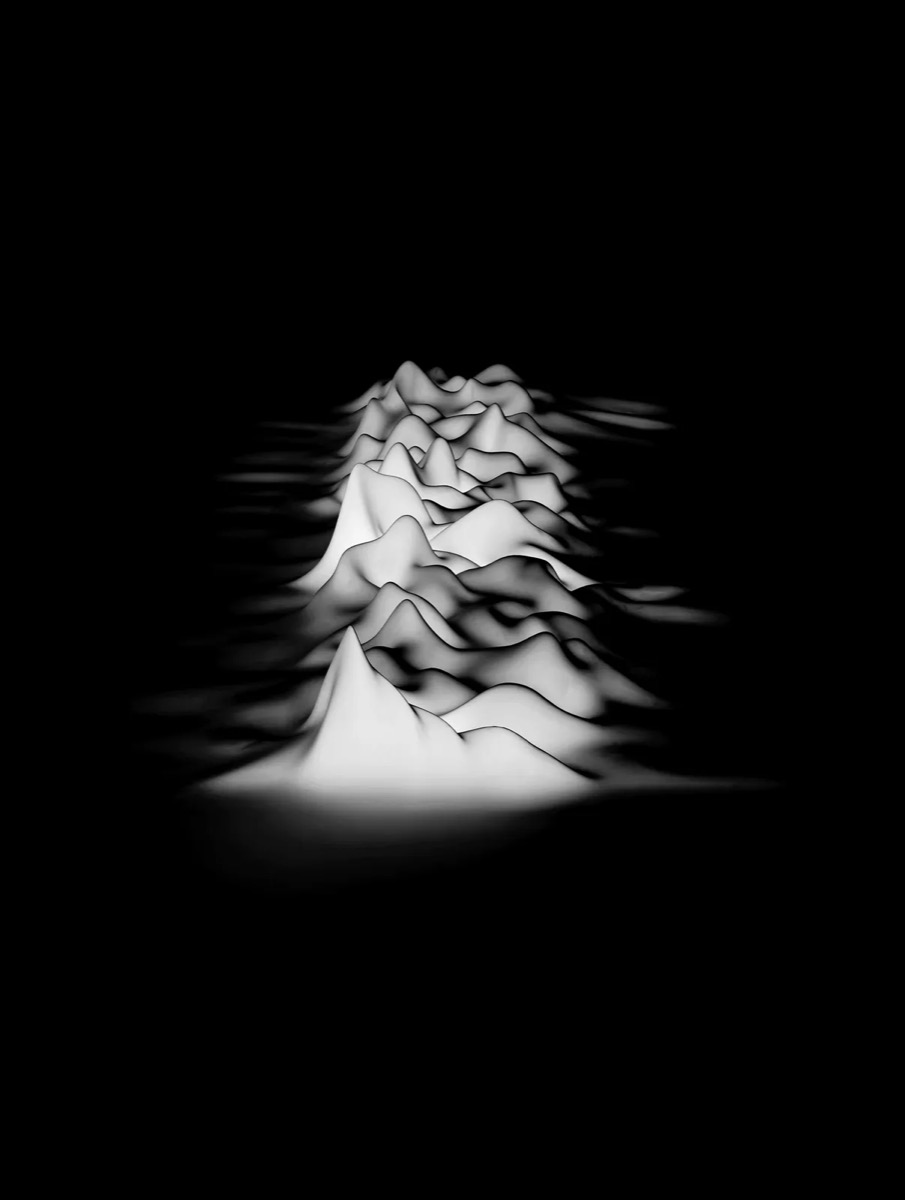
Peter Saville: Unknown Pleasures — Black
Peter Saville
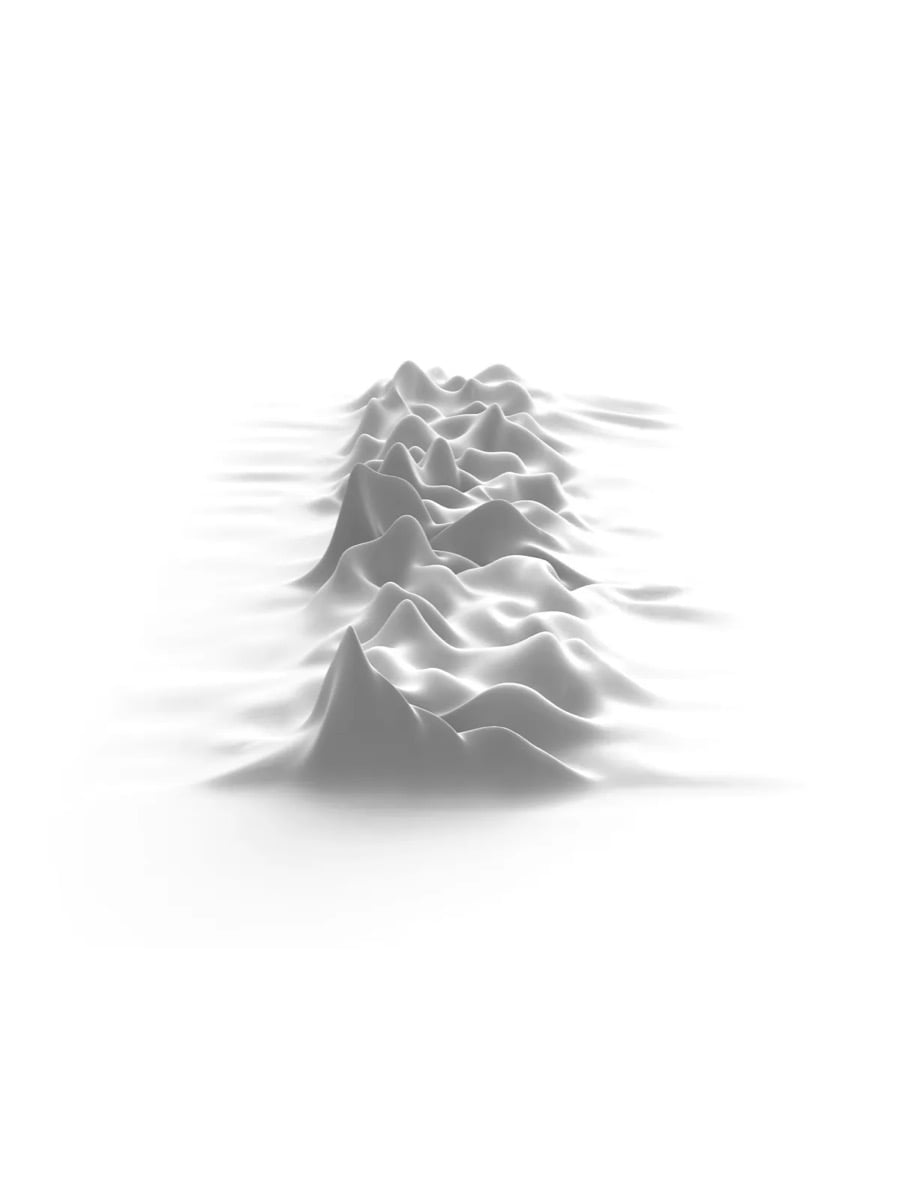
Peter Saville: Unknown Pleasures — White
Peter Saville
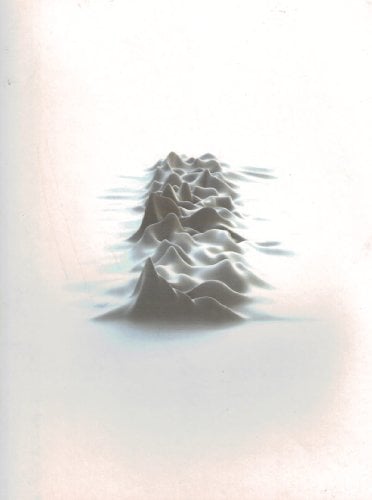
Designed by Peter Saville
Peter Saville / Princeton Architectural Press
How did a diagram end up everywhere?
What makes it iconic today is how far it has traveled beyond the album. It’s on T-shirts, tattoos, posters, sneakers, and countless parodies, and plenty of people who wear it have never heard Joy Division.
Disney even put Mickey Mouse on a version of it in 2012, which drew a fair amount of eye-rolling from fans. Few album covers have become a free-floating graphic symbol the way this one has.
Each entry here follows one of those appearances back to a source, with the maker and date recorded when the evidence supplies them.
Follow the image into the worldSources & credits
This history draws on interviews, scientific history, and museum records. Reviewed .
- Scientific American — Pop Culture Pulsar: interview with Harold Craft (2015)
- Scientific American — The Pulsar Chart That Became a Pop Icon Turns 50 (2020)
- Science Museum Group — FACT 10 Unknown Pleasures
- Cambridge University Press — Representing noise: stacked plots and radio astronomy (2023)
- Science and Industry Museum — Factory Records: cutting edge technology
- Manchester Digital Music Archive — The astronomy book page, photographed by Ian Tatlock
- MoMA — Peter Saville, Unknown Pleasures, 1979
- Rhino — Unknown Pleasures: 40th Anniversary Edition, 2019
- New Order — Unknown Pleasures at 40
- Paul Stolper — Peter Saville: Unknown Pleasures
- AbeBooks — Designed by Peter Saville, 2003
- Joy Division Central — independent archive, discography and concert history
The homepage’s pulse image is a cropped detail of the original sleeve from MoMA’s collection. Historical images here are source photographs and reproductions, credited above and on their archive entries. The Make your own tool creates new generative artwork and is labelled separately.